
Awaken to a Life of Spiritual Richness and Meaning
Discover the Transformative Power of Ancient Wisdom in Today's Modern World.
Discover your Path to Spiritual Growth
Embark on a transformative journey with Rabbi Ezagui.
“Seven Secrets” E-book
Uncover the profound wisdom and insights to guide you towards a deeper understanding of yourself and the world around you.
Inner Power Circle
Join a transformative program combining ancient wisdom, cutting-edge science & a vibrant community to help you unlock your highest potential.
Inner Power Circle
Join a transformative program combining ancient wisdom, cutting-edge science & a vibrant community to help you unlock your highest potential.
Redefine Your Reality: The Joy Perspective
In free video, you will gain the tools & insights needed to combat the pressures affecting your peace of mind. Delve into psychology and explore the meanings we attach to our life experiences.
About Rabbi Shlomo Ezagui

Your Spiritual Leader
With over 36 years in the rabbinate, Rabbi Shlomo Ezagui combines profound insights from Jewish Law and spirituality with personal experiences to guide individuals towards joy and fulfillment. His mission is powered by a deeply-held belief in everyone's potential to embrace a more joyful life.
Rabbi Ezagui is more than a spiritual leader. He's a mentor and guide who comprehends life's challenges and aims to help you overcome them
Read Our Latest Blogs
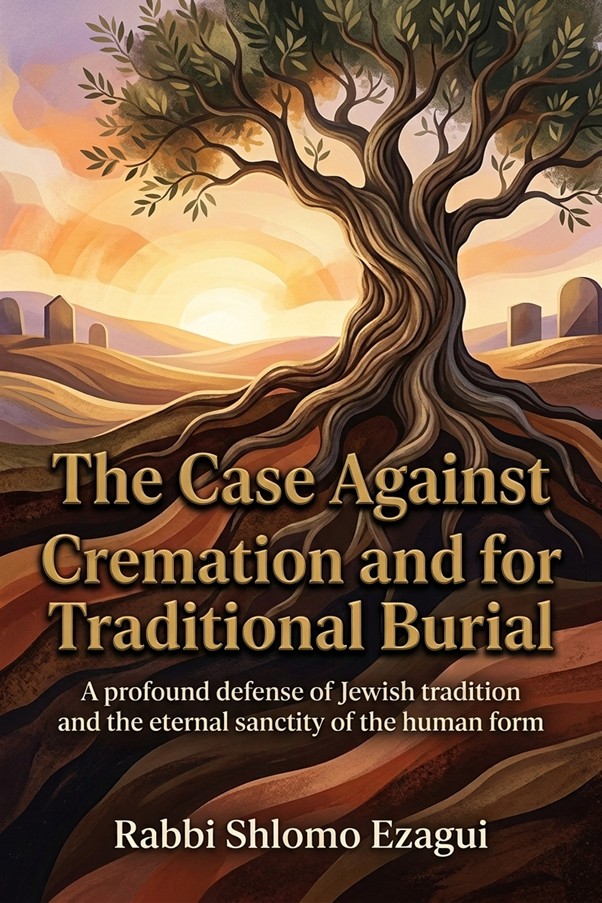
The Case against Cremation and for Traditional Burial
The Midrash tells: When Cain killed his brother Abel, it was the first death the world had ever known, and Adam and Eve were overcome with shock and grief. They sat beside Abel’s lifeless body, weeping and unsure what to do, for no human being had yet faced such a moment. Abel’s faithful dog stood guard over the body, protecting it from wild animals and birds, as if sensing the dignity owed to its master’s body even in death.
As they mourned in confusion, a raven descended from the sky that had just experienced loss. In an act that seemed almost deliberate, the raven took its dead companion’s body, scratched at the earth with its claws, and buried it beneath the soil. Watching this, Adam understood the lesson being shown to him.
Turning to Eve, Adam said, “Let us do as this raven has done.” And so, for the first time, they placed a human body in the ground and covered it with earth, learning from the (otherwise cruel) creature of the world the proper way to honor and show dignity to the dead, returning man to the dust from which he was formed.
The question of cremation versus burial in Judaism is not merely a matter of tradition or preference; it reflects a deeply rooted worldview about the human being, the relationship between body and soul, and humanity’s responsibility to the Creator. Jewish burial arises from a comprehensive framework of Torah law, philosophy, and spiritual sensitivity. Far from being an outdated custom, it represents a consistent, principled approach articulated in Tanach, developed in the Talmud, codified in halakha, and illuminated in later works such as Kabbalah and Chassidut.
At the foundation of the Jewish view lies a fundamental theological premise: the human body is not owned by the individual but entrusted to the individual by God. This concept is implicit in the verse, “The souls are Mine” (Ezekiel 18:4), and rabbinic interpretation extends it to the body as well. The Talmud (Ta’anit 11a) teaches that a person does not have absolute ownership of himself, and the Rambam codifies this principle in Hilchot Avel 12:1, ruling that burial is a positive commandment. The Sefer HaChinuch (mitzvah 537) explains that this mitzvah reflects the honor due to the human form created in the image of God.
Chassidic teachings further deepen this understanding. In Tanya (Iggeret HaKodesh, epistle 20), the Alter Rebbe explains that the soul’s purpose is fulfilled specifically through its interaction with the physical body. Mitzvot are performed through physical action, transforming the material world into a מקום לדירה לו יתברך—a dwelling place for the Divine. The body is therefore not incidental to spiritual life but essential to it. To destroy the body is to disregard the very instrument through which divine purpose is realized.
This idea is closely tied to the halakhic obligation of כבוד המת (honoring the deceased). The Gemara (Berachot 18a) states that the deceased are aware of the honor shown to their bodies, and the Shulchan Aruch (Yoreh De’ah 348) codifies detailed laws governing dignified burial. Cremation causes great suffering to the soul.
The prohibition of ניבול המת (disgracing the dead) underscores that the body retains sanctity even after death. Just as a Torah scroll that is no longer usable must be buried respectfully (Megillah 26b), so too must the human body—having housed a divine soul—be treated with reverence.
A central scriptural foundation for burial appears in Genesis: “For dust you are and to dust you shall return” (Genesis 3:19). This is reinforced by Psalm 146:4: “When his spirit departs, he returns to his earth; on that day his plans perish.” The Talmud (Sanhedrin 46b) derives from verses such as “you shall surely bury him” (Deuteronomy 21:23) that burial is obligatory, not optional. The Ramban (commentary on Genesis 3:19) explains that returning to the earth is part of creation’s natural and intended order.
These sources establish what may be called the “law of return.” The soul returns to its divine source, while the body returns to the earth from which it was formed. The phrase “his earth” (לאדמתו) suggests a personal, natural homecoming. Halakha therefore requires that the body be placed in the ground, neither indefinitely preserved nor destroyed by fire. The Shulchan Aruch (Yoreh De’ah 362) rules that burial must take place in the earth itself, and customs such as using simple wooden caskets or drilling holes in the casket ensure eventual contact with the soil.
This requirement underscores a fundamental distinction between burial and cremation. Burial allows gradual, natural decomposition, aligning with the Torah’s vision of returning to the earth. Cremation, by contrast, reduces the body to ashes within hours through intense fire. From a halakhic standpoint, Rabbinic authorities regard cremation as violating the obligation to bury and the prohibition against destroying the body. From a Kabbalistic perspective, the Zohar (Parashat Vayechi) and later writings of the Arizal describe decomposition as part of the soul’s continued rectification (תיקון). Interfering with this process is therefore spiritually harmful.
The environmental dimension adds an unexpected yet important layer to this discussion. Cremation is often presented as environmentally friendly, yet it requires temperatures of approximately 1000 °C, achieved by burning fossil fuels, resulting in significant carbon emissions and the release of harmful substances such as mercury. Traditional Jewish burial, by contrast, aligns closely with modern principles of sustainability. The prohibition of embalming (based on the requirement to allow natural decomposition) and the use of simple wooden caskets (Shulchan Aruch, Yoreh De’ah 362) ensure minimal environmental impact. In Eretz Yisrael, the widespread practice of burial without caskets, using only tachrichim (simple linen shrouds), reflects an even more direct return to the earth.
Beyond law and philosophy, Jewish burial addresses the psychological needs of the living. Mourning in Judaism is a structured process with stages such as shivah, shloshim, and the annual yahrzeit. The grave plays a central role in this process. It serves as a מקום קבוע, a fixed place where memory and identity are anchored. The practice of visiting graves, mentioned in sources such as Ta’anit 16a, allows mourners to connect, reflect, and pray. The grave benefits both the deceased and those who come to visit.
The contrast with cremation is stark. When ashes are scattered or kept without a permanent resting place, the sense of continuity weakens, and future generations lose a tangible connection to their ancestors. Jewish tradition places immense value on memorial and continuity—“זכר צדיק לברכה” (Proverbs 10:7)—and a physical place of burial helps sustain that memory over time.
This issue also carries profound historical weight. In the shadow of the Holocaust, the burning of Jewish bodies became a symbol of ultimate desecration. Although halakha does not base its prohibitions on historical associations alone, the emotional and communal resonance cannot be ignored. Burial affirms dignity and continuity, standing in direct opposition to attempts to erase them.
Philosophically, Judaism rejects the dualistic notion, rooted in Greek thought, that the body is merely a prison for the soul. Instead, it affirms a holistic partnership between body and soul. The Midrash (Sanhedrin 91b) teaches that both body and soul are jointly accountable and will therefore be reunited in the resurrection of the dead, תחיית המתים. The Rambam (Hilchot Teshuvah 8:2) and the Ramban (Sha’ar HaGemul) elaborate on the enduring significance of the physical dimension. Respect for the body after death reflects its enduring role in the divine plan.
Practical concerns are also addressed within halakhic and communal frameworks. The perception that cremation is significantly cheaper often stems from modern funeral industry practices rather than from halakhic requirements. Jewish law mandates simplicity and equality in burial (Moed Katan 27b), a reform attributed to Rabban Gamliel to prevent embarrassment for the poor. Simple burials, facilitated by the Chevra Kadisha burial societies, often eliminate unnecessary expenses.
Underlying these elements is a broader spiritual message. The verse in Psalms concludes, “on that day his plans perish,” underscoring human limitation. Burial becomes an act of humility and acceptance, aligning human action with divine will. It is described as חסד של אמת (Sotah 14a), a true kindness performed without expectation of return.
In an age that prioritizes convenience and personal autonomy, the Jewish commitment to burial affirms the sanctity of the human body. Having served as the vessel for a divine soul and the instrument of a life of mitzvot, the body must be returned to the earth with dignity and care. Through its integration of Torah law, philosophical depth, environmental awareness, and psychological insight, Jewish burial continues to express a timeless vision of respect for both life and death.
Hear from others who have been transformed by Rabbi Shlomo Ezagui's teaching
Richard Kradin, M.D
Harvard Medical School Massachusetts General Hospital
Director of Pulmonary Immunology and Molecular Biology
MGH Center for Psychoanalysis
Professor Harvard Medical School

I have known Rabbi Ezagui for several years. He is endowed with a keen intellect, psychological acuity, and broad knowledge of many topics that extend beyond the confines of religion. With a specific focus in the areas of nexus between modern physics and Kabbalah, his life's work has been devoted to sharing these ideas with others with genuine concern and compassion. I can recommend Rabbi Ezagui, with no compunctions, for virtually any enterprise to which he chooses to devote himself
Gary Walk, Esq
Graduated from Yale University, B.A., summa cum laude, 1974 Harvard University, J.D., 1977,
I have known Rabbi Ezagui for many years, and have been a student in his diverse and lively Talmud class for several years. To Reform students who want a deeper understanding of Judaism, he offers answers to basic questions without condescension, and to Orthodox students, he provides affirmation and adds to their knowledge. He combines his extensive knowledge of Jewish law, history and spirituality with a rare ability to encounter every student in a way that is personal to him
© 2026 Rabbi Shlomo Ezagui - All Rights Reserved